We've detected that you're using an unsupported browser. You may experience issues using the OA website. Please visit our supported browsers page for more information.

OA

Chief William Stumpp

William A. Stumpp was always called “Chief”. Chief Stumpp was a long serving Scout Executive in the Greater New York Councils for The Bronx. He also was Camp Director at Camp Ranachqua, a camp along Kanawaukee Lakes. From that position Chief Stumpp initiated many lodges into Wimachtendienk including founding the Order's fourth lodge, Ranachqua Lodge, in 1920 to serve his own council. Stumpp is credited with starting more lodges than any other Arrowman by spreading the word to the camps around Kanawaukee Lake. Among the lodges Stumpp is credited with starting are Cowaw, Wawonaissa, Pamrapaugh, Chappegat and Shu Shu Gah lodges.

In 1923 Stumpp was elected the third Grand Lodge Scribe. During his term in 1924 he created what is known today as the National Bulletin. On October 31, 1924 Stumpp became the 31st Third Degree (Vigil) honor member. Stumpp’s Vigil name meant “Singing One”. In 1926 Stumpp became the sixth Grand Lodge Chieftain of Wimachtendienk.

While speculation has often been that Stumpp was called “Chief” because he had been a Grand Lodge Chieftain, or long serving Scout Executive or Camp Director, but none of these was the reason. Chief Stumpp was called “Chief” because he was, and always will be, the longest serving lodge chief in the Order’s history. Stumpp became the first chief of Ranachqua Lodge in 1920 when the lodge was formed. That was the custom of the day that the Scout Executive as Supreme Chief of the Fire was often the chief of the lodge. However, long after Scout Executives gave up the position and let other, typically young men, serve as lodge chief, Stumpp continued holding that office. Stumpp finally stepped down as lodge chief of Ranachqua Lodge in 1949 after serving for 29 years. Stumpp was forced to step down after the OA became an official BSA program and adults could no longer serve as lodge officers.

Stumpp was acknowledged for his years of service in 1940 at the National Meeting when he was awarded one of the inaugural 11 Distinguished Service Awards. His certificate recognized Stumpp for his “wise discretion” and “forceful perseverance.”

3, OA, Profile, Scouting


First Membership Cards

To the best of our knowledge the Wimachtendienk did not issue membership cards prior to the formation of the Grand Lodge in 1921. However, there is an example of a receipt for dues paid that dates back to 1918-19.

In 1921, the year the Grand Lodge was formed, Unami Lodge issued a beautiful membership card solely for its own members. The card had membership information on the front side and a picture of the lodge that was built on Treasure Island on the reverse. This 1921 membership card is the earliest known local lodge or Grand Lodge issue.

Unami Lodge continued their tradition of issuing their own membership card for many years. Unami was not the only local lodge that maintained their own membership cards throughout the history of the Wimachtendienk/Grand Lodge/National – Order of the Arrow.

3, Insignia, OA, Scouting


Sixth Lodge Formed

Umpah Lodge of Uniontown City Council, Pennsylvania became the Wimachtendienk’s sixth lodge on June 7, 1921. Umpah disbanded in 1925 and formed a non-Wimachtendienk honor society. In 1939 the Order would return to the area with a new name, Wagion Lodge 6.

3, OA, Scouting


First Ceremony

There is no written copy of the ritual used for induction of members into the Order throughout the 1915 Treasure Island camping season.

In 1965 the Unami Lodge released a copy of a ceremony purported to be the first ceremony. However, after discussions with Arrowmen active in the Lodge in 1965 and with the 1975 Lodge Chief, Phil Hittner, it is clear that the “first ceremony” released was a composite of later ceremonies and editorial license was taken based on what was believed to have happened. Factually the following is known:

- Robert Craig and Gilpin Allen were the first two inductees on July 16, 1915.

- E. Urner Goodman was the Chief of the Fire and wore a black robe similar to a graduation gown. He had a white triangular badge on his robe with a black tortoise superimposed on the white triangle.

- Carroll Edson was Sachem and wore a black robe, the same style as Goodman, with a while tortoise shaped badge on his chest.

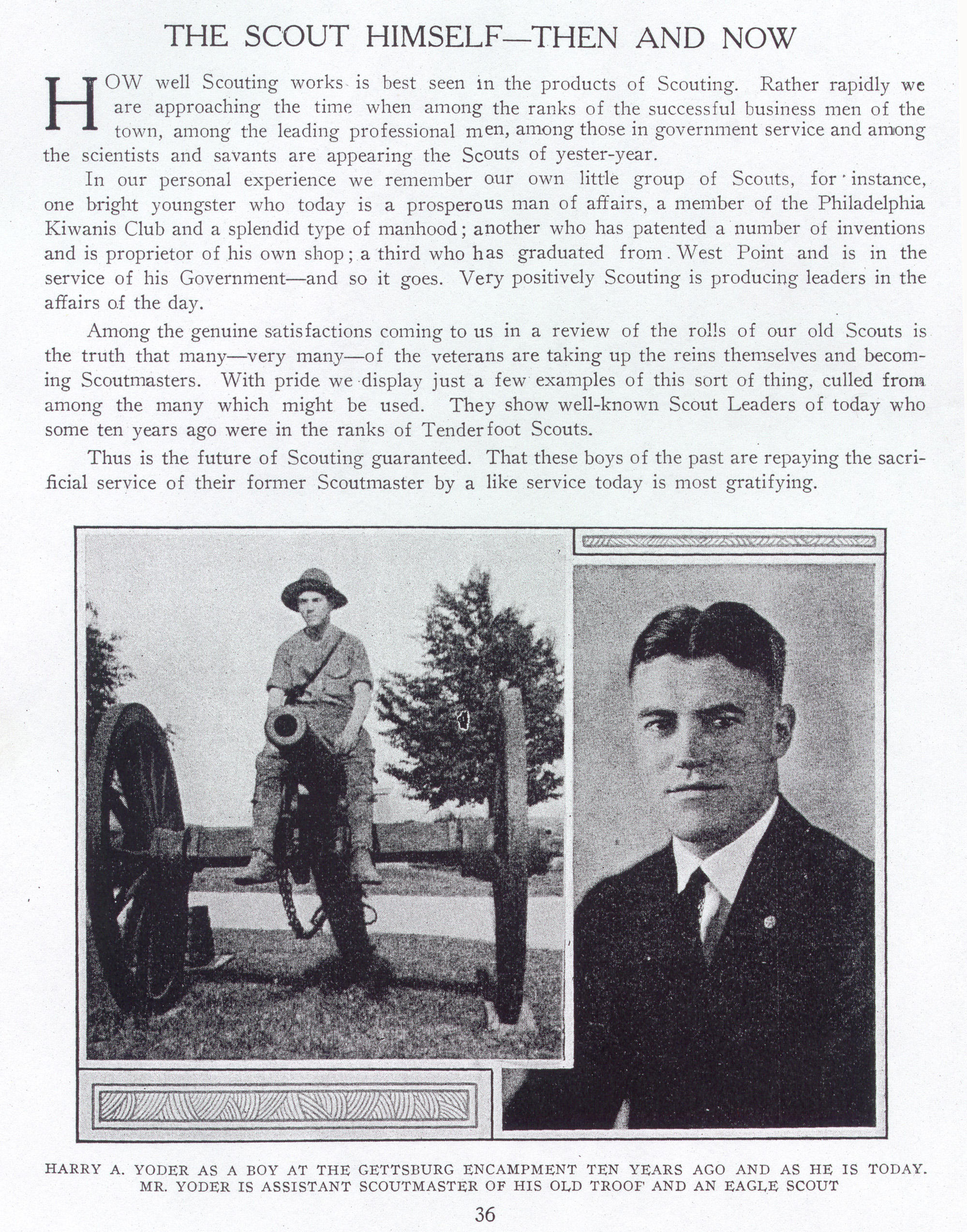
- Harry A. Yoder, a camp staffer guided the entire camp to the new campfire circle. He was the only camper who knew where the campfire circle was because he had helped construct it earlier in the day with Goodman. Yoder was not a ceremonialist for the First Ceremony.

- The two Scouts who were to be inducted wore a black sash. Stories share that the black sash could have had a simple white strip length-wise superimposed on the sash OR a white arrow superimposed on the sash. No original black sashes are known to exist.

The exact words spoken at the First Ceremony are not known, but some of the actions have been reported. Harry A. Yoder reported that there were two tests that each pledge/candidate was asked to complete.

The early candidates were handed a bundle of sticks and told to break it. After each had tried and failed, the Chief took the bundle and separating the sticks broke them one at a time with ease.

As a second lesson each scout was told to encircle a large tree with his arms. After each had tried and failed they were instructed to join hands and thus encircle the tree.

George W. Chapman, the first Chief of the Wimachtendienk, recalls the actions in the first ceremony in his unpublished manuscript The Arrow and the Vigil as follows:

Unfortunately, no written records were preserved of the original ceremony of induction. Urner Goodman recalls the three steps, or parts, of the original ceremony to be as follows:

1. An attempt on the part of each candidate to individually encircle with outstretched arms the trunk of a large tree, followed by a joint encircling of the same tree by the candidate and one of the officers of the Council Fire. In the first instance it was, of course, not possible for the candidate to reach around the tree. For two persons, it was a comparatively simple matter. This demonstrated Brotherhood.

2. The candidate was directed to make an endeavor to scale an elevation, adjacent to the Council Fire, unaided. Failing, he was then assisted by one of the officers of the Council Fire and with his help he was able to scale the elevation. This demonstrated the principle of Service.

3. The candidate was given a bundle of small dry twigs and told to place them on the Council Fire. When he did this the twigs caught fire readily and blazed up brightly. This demonstrated Cheerfulness.

E. Urner Goodman was asked by Horace Kern in 1925 on the 10th Anniversary of the Wimachtendienk to share his memories about the first ceremony in 1915. Goodman’s memory of the first ceremony was as follows:

The ritual was rather simple to start; indeed it can hardly be signified by the use of that term. The first Council fire, however, was accomplished with a great deal of dignity and Mr. Edson, who had much of the speaking part to carry through, used most solemn tones in so doing. In the early sessions part of the Ritual of the Camp Council fire consisted in what was termed, open initiation of the candidates for the Order. The several boys initiated each week were put through three steps in public before the entire camp Council fire but the meaning of those steps were not divulged until a later gathering that same evening with the boys. As I remember them the three steps were illustrative of the three stages of the Order and consisted of:

1. Attempting to encircle a trunk of a tree by each scout individually with outstretched arms followed by a joint encircling of the same tree by a candidate and one of the officers of the Council Fire. In the first instance it was, of course, not possible for the Scout to touch hands around the tree – for the two persons it was comparatively a simple matter. (Brotherhood)

2. A candidate was directed to make an endeavor to scale an elevation adjacent to the Council fire unaided. He then was assisted by one of the officers of the Council fire and he was able to scale. (Service)

3. My recollection of the third step is somewhat faulty. Perhaps I am wrong but I seem to remember that the candidate was expected to place a stick upon the Council fire thus making it burn more brightly while illustrating cheerfulness in his own countenance. (Cheerfulness)

Because there are no written copies of the ceremonies and no eyewitnesses remaining, it is difficult to know which memory is most accurate, however the concepts and feel of that First Ceremony is evident.

1, Ceremonies, Founders, Goodman, OA, Profile, Scouting


Harry Yoder

In the early part of July 1915, Mr. E. Urner Goodman, enlisted my aid in clearing what is today the ceremonial grounds of the Unami Lodge, on Treasure Island. Armed with an axe and a rake we prospected through the dense brush which covered the lower half of the Island, for a likely location and finally selected the present site.

The first ceremony took place on July 16, 1915. It was a great day for Treasure Island. It was my good fortune to act as guide and guardian of the trail on this auspicious occasion. The Scouts were gathered at dark around the flagpole and after being admonished to preserve silence were formed in a single file and led down by a circuitous route to the Council Fire.

---- Excerpted from a Harry A. Yoder article in Philadelphia Council Annual Report

Harry A. Yoder was one of the youth staff at Treasure Island in 1915. He was a trusted Scout who E. Urner Goodman enlisted to help him prepare the new Council Fire for the summer camp.

While Yoder was not considered a ceremonial team member in 1915, he was asked to be the guard and guide of the trail that led to the Council Fire because he was the only staff person who knew where it was located on the island.

Yoder was not inducted into the Wimachtendienk until the last week of camp in 1915. He met with his new brothers at Camp Morrell in November 1915 and was appointed the Chairman of the Membership Committee. In June 1916, his committee presented a report on membership in the Wimachtendienk and defined charter membership.

Yoder signed on as a charter member and remained active in the Wimachtendienk for a number of years. He was Unami Lodge Chief 1920-21. He was the fifth Third Degree member (Vigil) in the Wimachtendienk in 1921. As an adult Harry A. Yoder served as an Assistant Scoutmaster in Troop 3, Philadelphia.

1, Founders, Goodman, OA, Profile, Scouting

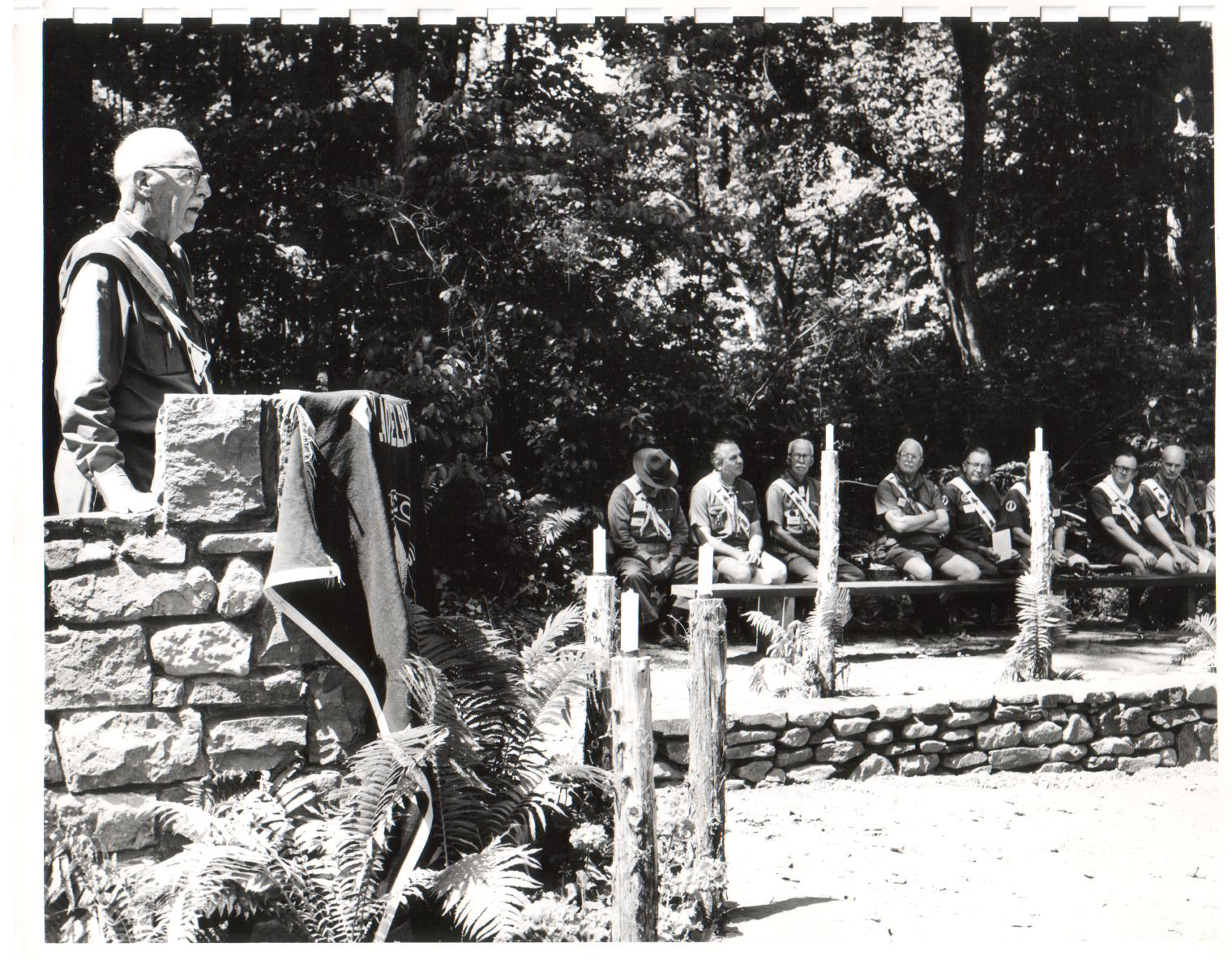
Treasure Island Ceremonial Grounds

George Chapman shared in his writings the following:

“Shortly after camp opened, Urner Goodman had explored Treasure Island in order to select the most appropriate place for the location of the Council Fire. He selected a site in the south woods of the island, far removed from the ordinary activities of the camp, and Edson agreed with him that it would be an ideal spot.

It was considerably off the beaten path on even a small 50-acre island and because of its location was an excellent site. How well Urner Goodman selected the site may be judged from the fact that the location of the Treasure Island Council Fire has never been changed.

The site chosen was a natural amphitheatre formed by a ravine in dense woods. For some natural reason there was a clearing here with sloping ground on one side which was to serve as a seating place for the spectators.

On the afternoon of the first induction Urner Goodman and Harry A. Yoder, by means of almost superhuman effort, were able to get the selected site cleared of brush, an altar built, and a path cut through the thick underbrush from the camp to the site.

1, Ceremonies, Founders, Goodman, OA, Profile, Scouting

First Sash (Black)

One of the enduring mysteries of the early days of the Wimachtendienk is the question of what the very first sashes of our Order looked like. There are two differing written accounts, both from extremely reliable eyewitnesses that were present at the beginning in 1915. Harry Yoder, the first guide and charter member of the Order, wrote circa 1921,

In the early days of the Order the members wore a black sash with a white stripe running lengthwise instead of the white band with the red arrow.

George Chapman’s account is slightly different. Chapman, also a 1915 Charter Member of Wimachtendienk and first youth leader had a different memory. His account in the unpublished work The Arrow and the Vigil (1953) states,

As has been previously mentioned, the officers of Wimachtendienk wore black robes for the induction ceremony. Members wore a black sash with a white arrow on it, very similar to the sash worn today except for the color.

There are no other written accounts of the first sash. Neither founder, nor any other charter member or adult support staff is known to have described the original sash. The 1916 Constitution is also silent on the construction of the sash. There are no known physical examples of a 1915 sash. We likely will never know which account is most accurate and the exact first sash will likely remain a mystery of the Order.

3, Insignia, OA, Scouting


First Vigil Honor Ceremony

At end of the camping season in 1915, E. Urner Goodman held a vigil on the Devil's Tea Table. There was no real ritual ceremony that accompanied his experience, just Goodman alone with his thoughts through a night that he often referred to as life changing for him.

Carroll A. Edson recalls the following as the events that happened at the end of the Camping Season in 1916:

By the summer of 1916 a basic organization had been set up, and essentially the present First Honor, a First Degree, as we then called it, ritual developed, and the lodge functioned actively at camp.

At the end of that season, there was a universal feeling among the members that Urner’s leadership had been so splendid that they should do something to raise him above the rest.

I was running a Sea Scout camp that summer, but at the end of the season ran up to Treasure Island for a few days. A few of us got together, and planned out what is now the Vigil Honor, but which was then called “Second Degree”. We developed the essentials of the present ordeal and ritual, and put Urner through it.

There is not a consensus among Wimachtendienk historians on whether or not the above quote is accurate and whether or not Goodman kept a second vigil. No ceremony existed for the Second Degree prior to 1916. Whether or not Goodman went through a Second Degree ceremony as defined by the 1916 Constitution of the Wimachtendienk and whom the identities of any ceremonialists were is unknown. If Goodman was not the first Arrowman to go through the actual ceremony for the Second Degree (Vigil) – because he had already kept his vigil prior to the ceremony being written, then Carroll Edson was the first to receive the full ritual in 1917.

3, Ceremonies, Founders, Goodman, OA, Scouting


First Annual Unami Lodge Banquet

At the end of 1916 Wimachtendienk held their first annual banquet. This is a tradition that is still observed every year by Unami Lodge. The Order’s first social event would expand to other social happenings including today’s conclaves, fellowships and conferences.

2, Founders, Goodman, OA, Scouting


Woodcraft Indians

It would help bring together young people from various so-called stations, break down the barriers that society has foolishly placed upon them, and establish in their minds when they are young a finer kind of humanity, a real understanding that the important thing is the association of a human spirit.

--- from Ernest Thompson Seton about his development of the League of Woodcraft Indians

The League of Woodcraft Indians was an American youth program, established by Ernest Thompson Seton. It was later renamed the "Woodcraft League of America". The program was also utilized overseas, and many of these overseas programs still exist today.

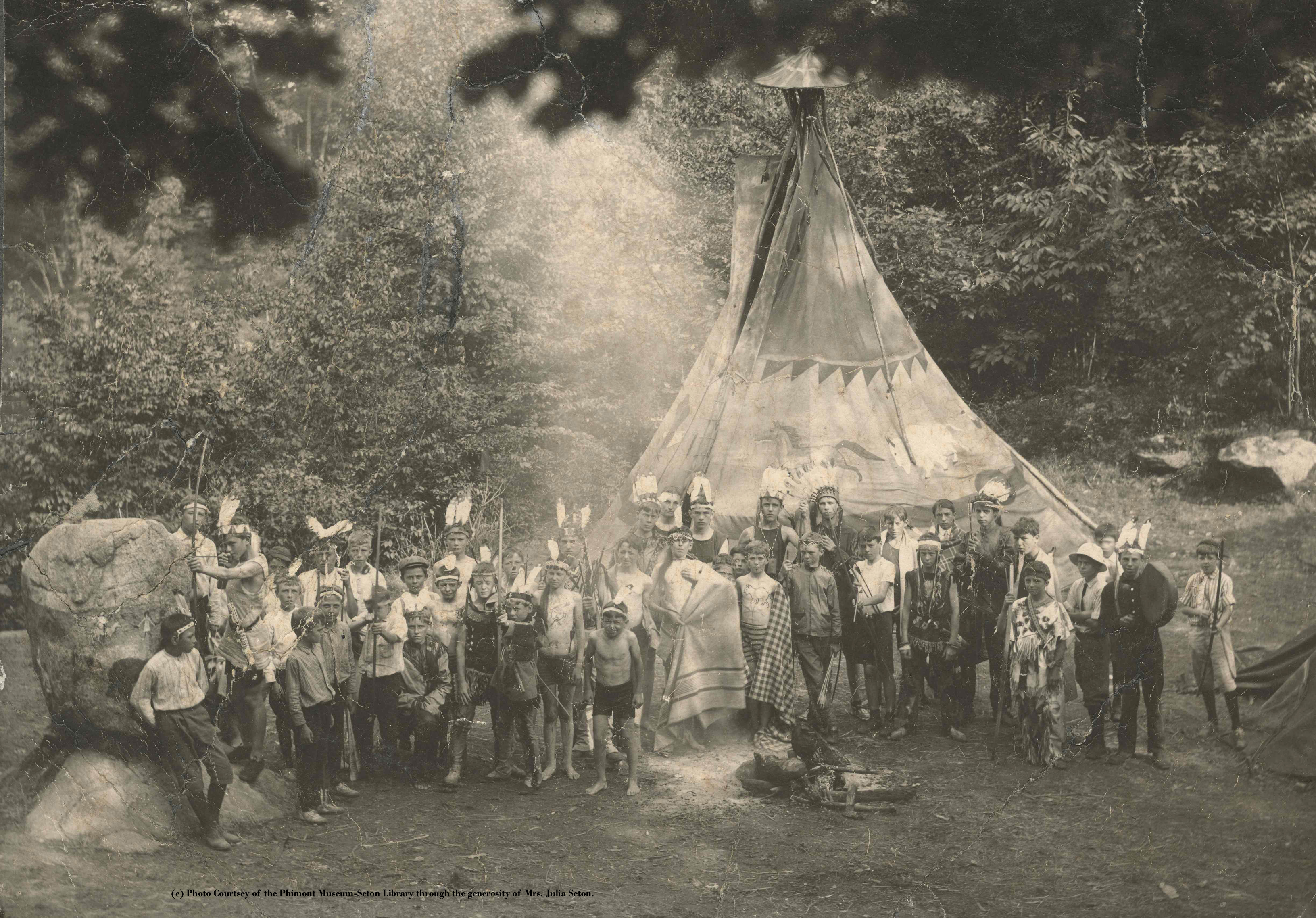
In the United States, the first Woodcraft "Tribe" was established in 1902 at Cos Cob, Connecticut. Seton's property had been vandalized several times by a group of boys from the local school. Seton thought over his options and decided that sugar might be better than vinegar. So he invited the boys over to his property for a weekend. Surprised and a little apprehensive the boys came. Seton, the great storyteller that he was, regaled the boys stories about Native Americans and nature.

The result of his weekend was a group of boys who became interested in nature and Native American customs and traditions. The unique feature of his program was that the boys elected their own leaders: a "Chief," a "Second Chief", a "Keeper of the Tally" and a "Keeper of the Wampum."

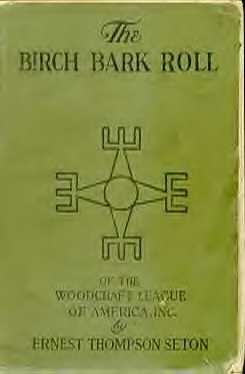
Encouraged by the boys’ response and a dream of broadening his program to other communities, Seton wrote a series of seven articles for Ladies' Home Journal from May to November 1902 under the heading "Seton's Boys." Those articles later were published under the name Birch Bark Roll.

Looking for people interested in his outdoor organization. Seton traveled to England in 1906 to meet with Lord Robert Baden-Powell. He gave Baden-Powell a copy of the Birch Bark Roll. Seton and Baden-Powell bonded around the concept of a program for youth. In 1908, Seton received a letter from Baden-Powell stating that he was going ahead with his vision for Scouting, using as a base Seton’s program. Baden-Powell wrote Scouting for Boys and incorporated many of Seton’s ideas, honors and games into his book.

3, Founders, OA, Profile, Scouting


Goodman & Edson Camp Directors

In April of 1915, E. Urner Goodman and Carroll A. Edson both were hired by Philadelphia Council and entered Professional Scouting at the age of 23. Philadelphia Scout Executive Walter S. Cowing appointed them both as  Field Commissioners (now called Field Executives). The following month the Philadelphia Council Camp Committee appointed Goodman as Camp Director at Treasure Island Scout Reservation and Edson as his Assistant Camp Director in charge of commissary. Together they prepared for the coming camp season and in their capacity as Camp Director and Assistant Camp Director determined that a camp fraternity might be a good idea for the camp.

1, Founders, Goodman, OA, Scouting


WWW Founded

Goodman and Edson had explained their plans for the establishment of a camp honor society to camp leaders at Treasure Island.

The date of the first induction had been set, July 16, 1915. Two of the Troops on the island had held an election of members.  George Chapman described the event in The Arrow and the Vigil as follows:

Friday, July 16, 1915, dawned bright and fair. In addition to the heavy heat, which often hangs in the valley of the Delaware, there was something else in the air. It was an almost indescribable feeling of expectancy and mystery. Only a very few of those on the island had been taken into the confidence of Goodman and Edson and this was done only to have sufficient personnel to carry out the planned program. So while everyone on the island was aware that Friday night was the big night, few knew exactly what was to take place and all waited with interest and an enthusiasm which was difficult to control.

The day wore on slowly. Ordinary camp activities provided little interest and the camp chores and duties were carried out with a total lack of enthusiasm. By sundown the air was charged with a tense excitement. Something that was to be a vital factor in the lives of uncounted thousands of boys and men was about to be started. The importance of this undertaking was unconsciously exerting a strange influence on those that were present.

The first members were inducted in a manner somewhat differently from the way in which the Ordeal is conducted today. All of the campers, obviously non-members, were witnesses to the induction. As darkness fell, Harry Yoder, who acted as first guide, lined up the campers in single file. In dead silence the campers followed the guide by a circuitous route to the Council Fire.

The path led under a fallen tree and the Council Fire was so located that as the boys approached the fire they had no knowledge of it until they passed under the tree and the Council Fire was suddenly revealed.

At the first induction, and on subsequent inductions during the first year of Wimachtendienk, Urner Goodman served as Chief of the Fire and Carroll Edson served as Vice Chief of the Fire. Both were dressed in black robes, similar to an academic robe, which had been made by Mrs. Cooper, the wife of a neighboring farmer. The Chief wore on his robe the totem of the Unami Clan of the Lenni Lenape Indians, a turtle, superimposed on a triangle, which denoted leadership. The Vice Chief of the Fire wore on his robe a turtle without the triangle.

The first candidates to be inducted into the organization were Robert Craig and Gilpin Allen. Goodman and Edson had no formal induction into the Order as it was felt that this was not necessary.

1, Ceremonies, Founders, Goodman, OA, Scouting