We've detected that you're using an unsupported browser. You may experience issues using the OA website. Please visit our supported browsers page for more information.

Scouting

Edson's Second Degree

There is a lack of consensus regarding the date of Carroll A. Edson’s Second Degree induction. Evidence exists that point to three different years: 1915, 1916 and 1917. (As an editorial decision the OA History Timeline has placed the date of Edson’s Vigil as 1917 as the most likely year based upon the evidence.)

The evidence that points to 1915 or 1916 as the year of Edson’s Second Degree is found in the writings of George W. Chapman. Chapman wrote the following excerpt that would seem to indicate that Edson kept his Second Degree (Vigil) in 1915 or 1916:

The second man on whom the Vigil Honor was conferred was Carroll Edson. The minutes of Unami Lodge carry a brief mention of this under the date of October 18, 1915, saying, ‘Carroll A. Edson, Sachem, was given the test. He was given the name Ahoweapowi, making him a member of the Second Degree.”

The Second Degree (Vigil Honor) was conferred at the annual fall meeting of Unami Lodge, held at Van Renesalaer Cabin, a week-end camping spot of the Philadelphia Council near Camp Hill, Montgomery County, Pennsylvania.

There are multiple errors of fact contained in this account. First, October 18, 1915 (a Monday) was prior to the first organizational meeting at Camp Morrell. The term Second Degree was not even in use in 1915, that required the framing of the 1916 Constitution of Wimachtendienk. Second, the term Unami Lodge had not been created yet, indeed it had not been invented by 1916 either. Finally, the first annual fall meeting of Wimachtendienk was not until 1916. It is believed that the above entry was written after the fact and was in error. Efforts to obtain copies of the Unami Minute Book have revealed that the book has not existed for decades.

The most persuasive account of Edson’s Second Degree initiation comes from the best possible source, Edson himself. Edson wrote a letter in 1942 to Moqua Chapter of Owasippe Lodge in Chicago at their request for the Moqua Chapter 20th Anniversary yearbook. In it Edson discussed the beginnings of the Wimachtendienk. As a part of that letter Edson shares the following story of his induction into the Second Degree:

… Shortly after that, I went to the National Staff, and shortly after that entered the Army. It was while in service, I believe in the fall of 1917, that I spent another weekend at one of the outlying camps of the Philadelphia Council, at an Order meeting. While there I received the 'Second Degree' initiation, we then called it – the present Vigil Honor.

This account is persuasive because it was written by Edson and he references specific events that also track to 1917. Edson was not on National Staff until 1917. He did not join the army until 1917 when the United States entered World War I. He has specific recall of being on Army leave (from New York) to travel to the fall Camp Van Renesalaer (the outlying camp) meeting for his initiation.

1, Ceremonies, Founders, OA, Scouting


Third Lodge Formed

Richmond Area Council, Richmond, Virginia formed Pamunkey Lodge 3 on November 25th, 1919. Pamunkey Lodge disbanded in the 1920s and lost its charter after not paying dues. In 1945 Richmond Area Council (now known as Heart of Virginia Council) revived the OA. The Council retained its original charter number and became Nawakwa Lodge.

3, OA, Scouting


First, Second and Third Degrees

The original Constitution of the Wimachtendienk written in 1916 describes the levels of membership as Pledge, First Degree and Second Degree. Although they are not spelled out in a separate article in the Constitution they are referred to in the section entitled Insignia as follows: 

The tortoise shall be the general insignia of the order:

- for the first degree the insignia shall be the arrow superimposed on the back of the tortoise;

- for the second degree the insignia shall be the triangle superimposed on the back of the tortoise.

- The pin of the order shall bear the above insignia;

- the pledge pin shall be the arrow.

The Pledge was the candidate who participated in the public induction ceremony at Treasure Island during the camping season and is most similar to today’s Ordeal Honor.

The First Degree was given to the Pledge who completed his initiation during the October annual “member’s only” meeting of the Lodge back in Philadelphia and is most similar to the Brotherhood Honor of today.

The Second Degree was given to a member of the Wimachtendienk whose life and service was far above the other members and is most similar to today’s Vigil Honor. The Second Degree was originally conceived by Goodman as being given to someone who did a heroic lifesaving type of deed.

By the late teens leaders of the Wimachtendienk decided to reorganize the honor levels in the Order. The term Pledge was dropped. A Scout initiated at summer camp would henceforth be called First Degree. What had previously been called First Degree would now be called Second Degree. The Second Degree would have a separate and distinctive ceremony from the one given at camp and no longer would be considered the second half of the initiation ceremony. The old Second Degree would be named the Third Degree.

These decisions were ratified in 1920 in the Second Constitution of Wimachtendienk:

5. DEGREE

A. Members attain the first degree through regular initiation at camp.

B. The second degree is conferred upon the first degree candidates present at the ceremonials in the city in the fall and spring.

C. The third degree shall be open to these members, in good standing, who are elected thereto by the third degree members, by reason of some heroic act, exemplary of the principles of the order, or of some special contribution to the welfare and spirit of the lodge. There shall at all times be at least one third degree member for each fifty active members of the lodge.

2, Ceremonies, OA, Scouting


Fourth Lodge Formed

Ranachqua Lodge 4 of The Bronx, New York formed Wimachtendienk’s fourth lodge on August 1, 1920.  The lodge was founded by William A. Stumpp, who served as their first lodge chief, a position that he held for more than two decades.

3, OA, Scouting


First Ceremony

There is no written copy of the ritual used for induction of members into the Order throughout the 1915 Treasure Island camping season.

In 1965 the Unami Lodge released a copy of a ceremony purported to be the first ceremony. However, after discussions with Arrowmen active in the Lodge in 1965 and with the 1975 Lodge Chief, Phil Hittner, it is clear that the “first ceremony” released was a composite of later ceremonies and editorial license was taken based on what was believed to have happened. Factually the following is known:

- Robert Craig and Gilpin Allen were the first two inductees on July 16, 1915.

- E. Urner Goodman was the Chief of the Fire and wore a black robe similar to a graduation gown. He had a white triangular badge on his robe with a black tortoise superimposed on the white triangle.

- Carroll Edson was Sachem and wore a black robe, the same style as Goodman, with a while tortoise shaped badge on his chest.

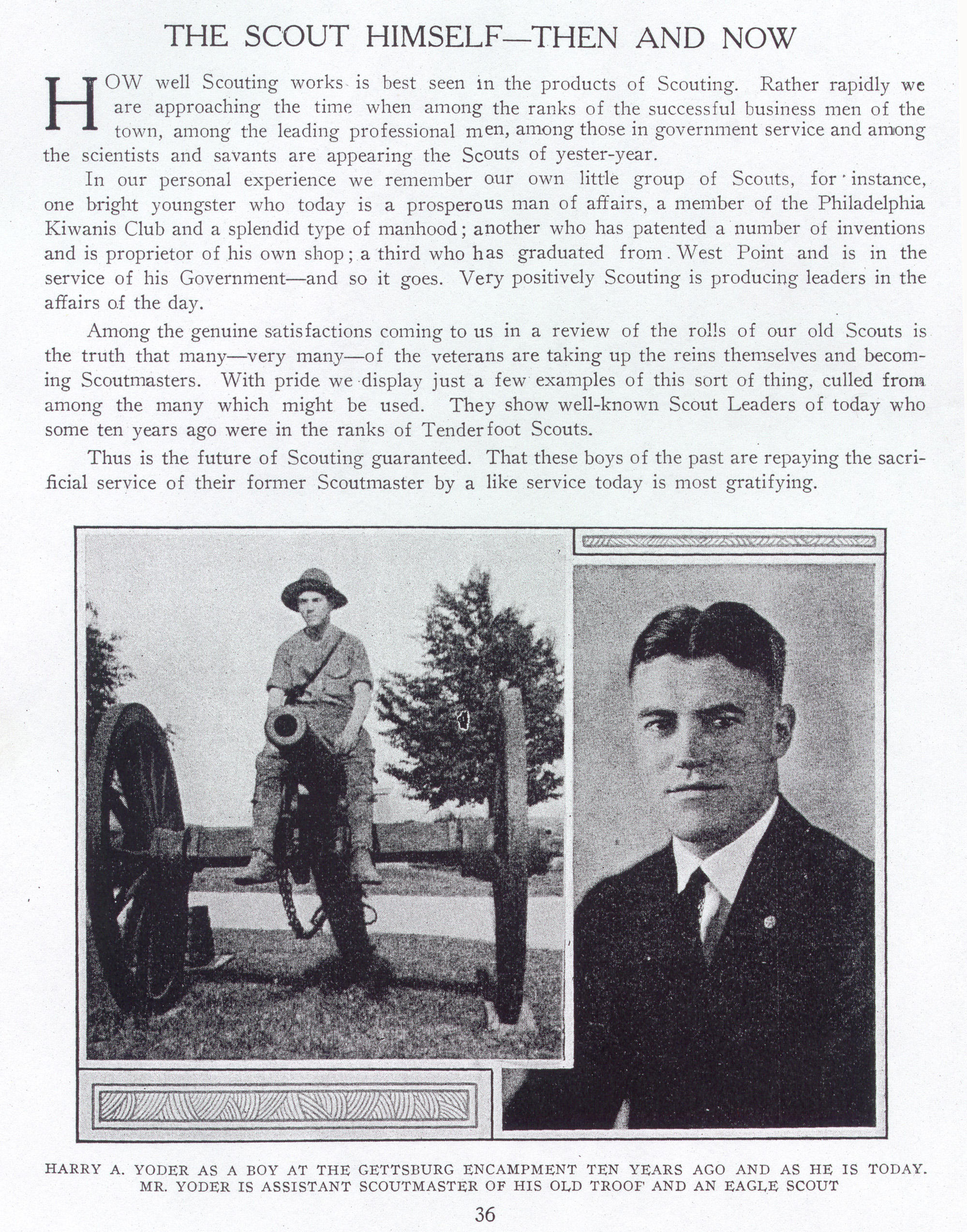
- Harry A. Yoder, a camp staffer guided the entire camp to the new campfire circle. He was the only camper who knew where the campfire circle was because he had helped construct it earlier in the day with Goodman. Yoder was not a ceremonialist for the First Ceremony.

- The two Scouts who were to be inducted wore a black sash. Stories share that the black sash could have had a simple white strip length-wise superimposed on the sash OR a white arrow superimposed on the sash. No original black sashes are known to exist.

The exact words spoken at the First Ceremony are not known, but some of the actions have been reported. Harry A. Yoder reported that there were two tests that each pledge/candidate was asked to complete.

The early candidates were handed a bundle of sticks and told to break it. After each had tried and failed, the Chief took the bundle and separating the sticks broke them one at a time with ease.

As a second lesson each scout was told to encircle a large tree with his arms. After each had tried and failed they were instructed to join hands and thus encircle the tree.

George W. Chapman, the first Chief of the Wimachtendienk, recalls the actions in the first ceremony in his unpublished manuscript The Arrow and the Vigil as follows:

Unfortunately, no written records were preserved of the original ceremony of induction. Urner Goodman recalls the three steps, or parts, of the original ceremony to be as follows:

1. An attempt on the part of each candidate to individually encircle with outstretched arms the trunk of a large tree, followed by a joint encircling of the same tree by the candidate and one of the officers of the Council Fire. In the first instance it was, of course, not possible for the candidate to reach around the tree. For two persons, it was a comparatively simple matter. This demonstrated Brotherhood.

2. The candidate was directed to make an endeavor to scale an elevation, adjacent to the Council Fire, unaided. Failing, he was then assisted by one of the officers of the Council Fire and with his help he was able to scale the elevation. This demonstrated the principle of Service.

3. The candidate was given a bundle of small dry twigs and told to place them on the Council Fire. When he did this the twigs caught fire readily and blazed up brightly. This demonstrated Cheerfulness.

E. Urner Goodman was asked by Horace Kern in 1925 on the 10th Anniversary of the Wimachtendienk to share his memories about the first ceremony in 1915. Goodman’s memory of the first ceremony was as follows:

The ritual was rather simple to start; indeed it can hardly be signified by the use of that term. The first Council fire, however, was accomplished with a great deal of dignity and Mr. Edson, who had much of the speaking part to carry through, used most solemn tones in so doing. In the early sessions part of the Ritual of the Camp Council fire consisted in what was termed, open initiation of the candidates for the Order. The several boys initiated each week were put through three steps in public before the entire camp Council fire but the meaning of those steps were not divulged until a later gathering that same evening with the boys. As I remember them the three steps were illustrative of the three stages of the Order and consisted of:

1. Attempting to encircle a trunk of a tree by each scout individually with outstretched arms followed by a joint encircling of the same tree by a candidate and one of the officers of the Council Fire. In the first instance it was, of course, not possible for the Scout to touch hands around the tree – for the two persons it was comparatively a simple matter. (Brotherhood)

2. A candidate was directed to make an endeavor to scale an elevation adjacent to the Council fire unaided. He then was assisted by one of the officers of the Council fire and he was able to scale. (Service)

3. My recollection of the third step is somewhat faulty. Perhaps I am wrong but I seem to remember that the candidate was expected to place a stick upon the Council fire thus making it burn more brightly while illustrating cheerfulness in his own countenance. (Cheerfulness)

Because there are no written copies of the ceremonies and no eyewitnesses remaining, it is difficult to know which memory is most accurate, however the concepts and feel of that First Ceremony is evident.

1, Ceremonies, Founders, Goodman, OA, Profile, Scouting


Harry Yoder

In the early part of July 1915, Mr. E. Urner Goodman, enlisted my aid in clearing what is today the ceremonial grounds of the Unami Lodge, on Treasure Island. Armed with an axe and a rake we prospected through the dense brush which covered the lower half of the Island, for a likely location and finally selected the present site.

The first ceremony took place on July 16, 1915. It was a great day for Treasure Island. It was my good fortune to act as guide and guardian of the trail on this auspicious occasion. The Scouts were gathered at dark around the flagpole and after being admonished to preserve silence were formed in a single file and led down by a circuitous route to the Council Fire.

---- Excerpted from a Harry A. Yoder article in Philadelphia Council Annual Report

Harry A. Yoder was one of the youth staff at Treasure Island in 1915. He was a trusted Scout who E. Urner Goodman enlisted to help him prepare the new Council Fire for the summer camp.

While Yoder was not considered a ceremonial team member in 1915, he was asked to be the guard and guide of the trail that led to the Council Fire because he was the only staff person who knew where it was located on the island.

Yoder was not inducted into the Wimachtendienk until the last week of camp in 1915. He met with his new brothers at Camp Morrell in November 1915 and was appointed the Chairman of the Membership Committee. In June 1916, his committee presented a report on membership in the Wimachtendienk and defined charter membership.

Yoder signed on as a charter member and remained active in the Wimachtendienk for a number of years. He was Unami Lodge Chief 1920-21. He was the fifth Third Degree member (Vigil) in the Wimachtendienk in 1921. As an adult Harry A. Yoder served as an Assistant Scoutmaster in Troop 3, Philadelphia.

1, Founders, Goodman, OA, Profile, Scouting

Treasure Island Ceremonial Grounds

George Chapman shared in his writings the following:

“Shortly after camp opened, Urner Goodman had explored Treasure Island in order to select the most appropriate place for the location of the Council Fire. He selected a site in the south woods of the island, far removed from the ordinary activities of the camp, and Edson agreed with him that it would be an ideal spot.

It was considerably off the beaten path on even a small 50-acre island and because of its location was an excellent site. How well Urner Goodman selected the site may be judged from the fact that the location of the Treasure Island Council Fire has never been changed.

The site chosen was a natural amphitheatre formed by a ravine in dense woods. For some natural reason there was a clearing here with sloping ground on one side which was to serve as a seating place for the spectators.

On the afternoon of the first induction Urner Goodman and Harry A. Yoder, by means of almost superhuman effort, were able to get the selected site cleared of brush, an altar built, and a path cut through the thick underbrush from the camp to the site.

1, Ceremonies, Founders, Goodman, OA, Profile, Scouting

First Sash (Black)

One of the enduring mysteries of the early days of the Wimachtendienk is the question of what the very first sashes of our Order looked like. There are two differing written accounts, both from extremely reliable eyewitnesses that were present at the beginning in 1915. Harry Yoder, the first guide and charter member of the Order, wrote circa 1921,

In the early days of the Order the members wore a black sash with a white stripe running lengthwise instead of the white band with the red arrow.

George Chapman’s account is slightly different. Chapman, also a 1915 Charter Member of Wimachtendienk and first youth leader had a different memory. His account in the unpublished work The Arrow and the Vigil (1953) states,

As has been previously mentioned, the officers of Wimachtendienk wore black robes for the induction ceremony. Members wore a black sash with a white arrow on it, very similar to the sash worn today except for the color.

There are no other written accounts of the first sash. Neither founder, nor any other charter member or adult support staff is known to have described the original sash. The 1916 Constitution is also silent on the construction of the sash. There are no known physical examples of a 1915 sash. We likely will never know which account is most accurate and the exact first sash will likely remain a mystery of the Order.

3, Insignia, OA, Scouting


First Vigil Honor Ceremony

At end of the camping season in 1915, E. Urner Goodman held a vigil on the Devil's Tea Table. There was no real ritual ceremony that accompanied his experience, just Goodman alone with his thoughts through a night that he often referred to as life changing for him.

Carroll A. Edson recalls the following as the events that happened at the end of the Camping Season in 1916:

By the summer of 1916 a basic organization had been set up, and essentially the present First Honor, a First Degree, as we then called it, ritual developed, and the lodge functioned actively at camp.

At the end of that season, there was a universal feeling among the members that Urner’s leadership had been so splendid that they should do something to raise him above the rest.

I was running a Sea Scout camp that summer, but at the end of the season ran up to Treasure Island for a few days. A few of us got together, and planned out what is now the Vigil Honor, but which was then called “Second Degree”. We developed the essentials of the present ordeal and ritual, and put Urner through it.

There is not a consensus among Wimachtendienk historians on whether or not the above quote is accurate and whether or not Goodman kept a second vigil. No ceremony existed for the Second Degree prior to 1916. Whether or not Goodman went through a Second Degree ceremony as defined by the 1916 Constitution of the Wimachtendienk and whom the identities of any ceremonialists were is unknown. If Goodman was not the first Arrowman to go through the actual ceremony for the Second Degree (Vigil) – because he had already kept his vigil prior to the ceremony being written, then Carroll Edson was the first to receive the full ritual in 1917.

3, Ceremonies, Founders, Goodman, OA, Scouting


First Annual Unami Lodge Banquet

At the end of 1916 Wimachtendienk held their first annual banquet. This is a tradition that is still observed every year by Unami Lodge. The Order’s first social event would expand to other social happenings including today’s conclaves, fellowships and conferences.

2, Founders, Goodman, OA, Scouting


"Service" Influences Formation

From 1914 – 1916 the Philadelphia Council led by Scout Executive Walter S. Cowing used “Service” as its watchword. In 1914 the council recognized deserving individuals with a special “Badge of Service” pin.

3, OA, Scouting


Goodman Influenced - Story of Billy Clark

When the Treasure Island staff planned the first induction, Urner Goodman had one Scout in mind as the model of cheerful service he wanted for its members - Billy Clark.  Billy was a member of Philadelphia's Troop 1, led by Scoutmaster Goodman and is listed in their records as an “Assistant Scribe.” Years later Goodman described a troop campout at Treasure Island.

One time during our stay there, one of our charges came with a minor sickness. There was no medicine, no hospital on the island at all. So he had to stay in his tent and he had to be taken care of. Billy volunteered to be our live-in nurse for the two or three days he had to be there. And he did a good job of it.

Came to a crisis however the next morning. It had rained during the night. Now, there is a vessel used in hospitals they call a bedpan.  And it was time to take that thing to the latrine and Billy, of course, cheerfully took on the assigned visit. However, in going from the tent to the latrine he had a little upset. It was the wrong kind of bath, to be put lightly. But Billy got up smiling from it all, if you can imagine. Now that's the picture of cheerful service.


1, Founders, Goodman, OA, Profile, Scouting